

For many employers across the United States, hiring has become more challenging than ever. Manufacturers struggle to fill production roles, construction companies delay projects due to understaffed and logistics firms are in constant search for drivers and warehouse workers.
The problem is simple, there are not enough workers.
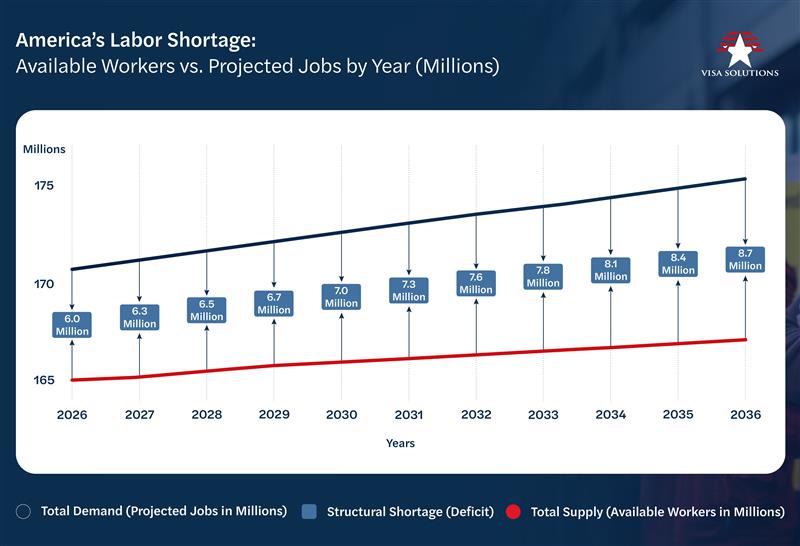
However, this is not the first time the United States has faced a labor shortage. In the late 1800s, American industries faced a similar challenge. As railroads were expanding, factories were multiplying, and farms were growing across the country. employers needed a rapid influx of labor.
Between 1870 and 1900, nearly 12 million immigrants arrived in the United States to work in railroads, factories, mines, and agriculture. Those workers built the infrastructure that powered American economic growth for the next century
Today, economists warn that the U.S. workforce may shrink as millions of baby boomers retire and fewer young workers enter skilled trades. The Manufacturing Institute estimates that the manufacturing sector alone could face up to 2.1 million unfilled jobs by 2030.
For many employers, the question is no longer whether labor shortages exist but how to solve them. Some companies are exploring international workforce programs that allow businesses to legally recruit workers from abroad when positions cannot be filled locally.
History suggests a compelling precedent: When America needed workers before, it looked beyond its borders. Many employers are now asking whether that strategy could be the key to future stability.
Take this short assessment to find out if your company may qualify to apply for international workforce programs. If eligible, you’ll be guided to the next step.
1. Is your company in any of the following industries: Manufacturing, Construction, Logistics, Technology, Healthcare, or Hospitality?
2. Are you currently experiencing difficulty filling certain roles?
3. Do open positions typically remain unfilled longer than 2 months?
4. Are the positions critical to your business?
5. Have you recently increased recruiting efforts, and yet still struggle to find qualified candidates?
6. Do you anticipate needing more workers in the next 12–24 months?
7. Would your company be open to exploring legal employment-based immigration programs to stabilize your workforce?
Congratulations, you qualify!
Enter your company info below to get your custom international hiring strategy from Visa Solutions.
Based on your responses, this specific workforce strategy may not be the right fit right now.
That said, we’d still be happy to share insights and alternative approaches that could support your hiring goals.
Thank you for your interest. Based on your answers, it seems your company may not qualify at this time.
Discover how U.S. companies hire
international workers legally.